Longevity is powerful.
But it comes with a challenge.
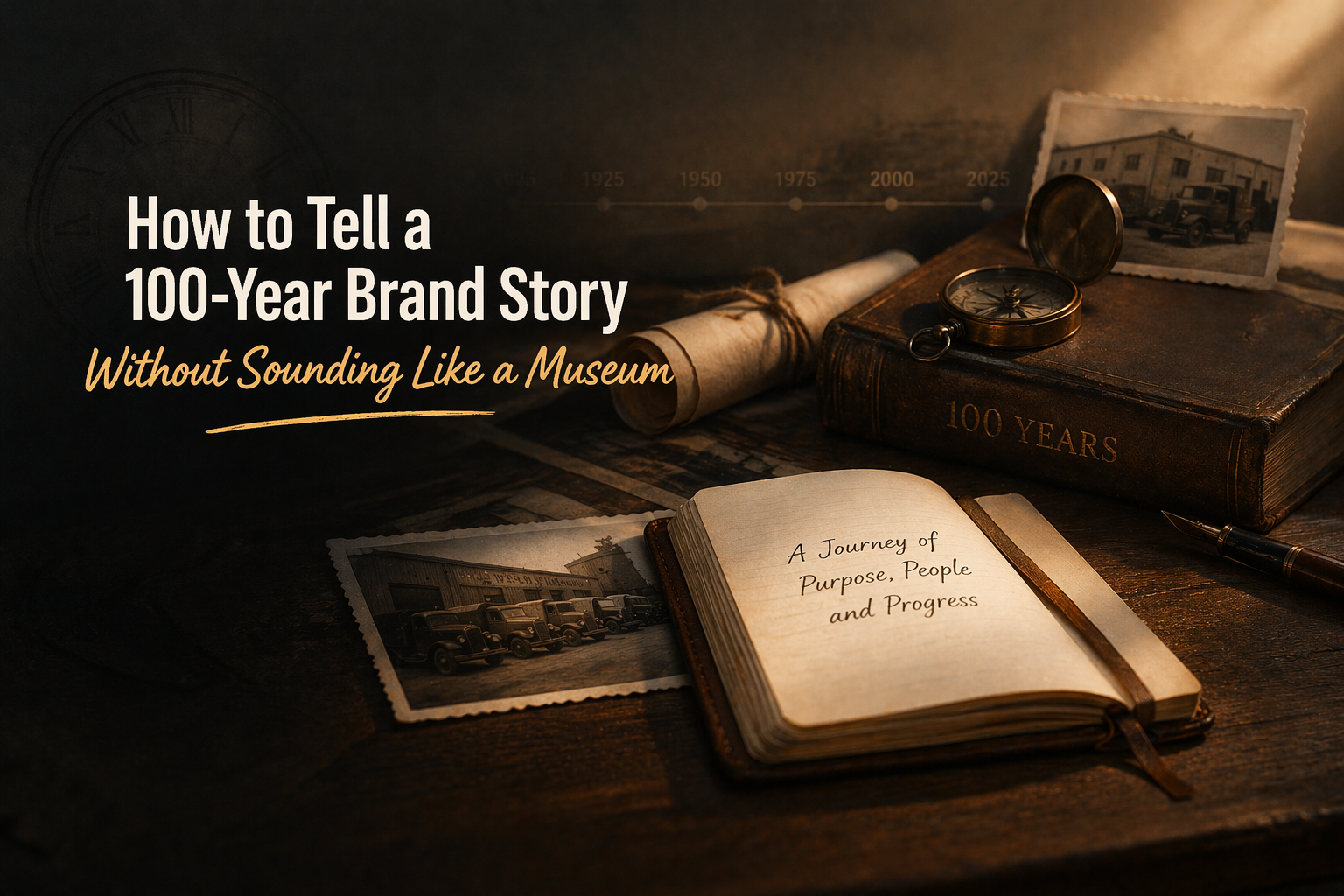
When a brand has existed for decades—or over a century—its story risks being told like a timeline: dates, milestones, achievements, and legacy points neatly arranged.
The result?
A narrative that feels important, but distant.
Informative, but not engaging.
In other words: it starts to sound like a museum.
The Problem with “Museum Storytelling”
Many legacy brand films fall into the same pattern:
- “Founded in…”
- “Expanded to…”
- “Achieved…”
- “Celebrating X years…”
While all of this is true, it often lacks:
- Emotional connection
- Human perspective
- Narrative tension
It tells what happened, but not why it matters today.
And that’s where attention is lost.
Shift the Lens: From Timeline to Story
A 100-year brand story should not be about everything that happened.
It should be about:
👉 What has remained constant
👉 What has evolved
👉 What it means now
Instead of asking:
“What should we include?”
Ask:
“What is the story we are really telling?”
Because a documentary is not a record.
It is a point of view.
Find the Throughline
Every enduring organization has something that runs through time:
- A philosophy
- A way of working
- A belief system
- A relationship with customers or communities
This is your throughline.
It connects:
- Past to present
- Founders to current leadership
- Early challenges to future ambitions
Without this, a legacy story becomes fragmented.
With it, the story gains continuity and meaning.
Put People at the Center
Time doesn’t tell stories.
People do.
A 100-year journey is not made of milestones—it’s made of:
- Decisions
- Risks
- Failures
- Adaptations
Featuring real voices:
- Employees
- Leaders
- Partners
- Long-time customers
…transforms the story from institutional to human.
And human stories are what people remember.
Avoid the Trap of Perfection
Legacy brands often want to present:
- Only successes
- Only polished narratives
- Only “safe” messaging
But that creates distance.
What makes a story engaging is:
- Imperfection
- Struggle
- Turning points
Acknowledging challenges doesn’t weaken credibility.
It strengthens it.
Make the Past Serve the Present
One of the biggest mistakes in legacy storytelling is treating the past as the destination.
It’s not.
The past should:
- Provide context
- Build credibility
- Explain evolution
But the story must always answer:
👉 Why does this matter today?
Because the audience is not watching from the past.
They’re watching from the present.
Use Visual Language to Bridge Time
A powerful documentary doesn’t just talk about history—it shows it in a way that feels alive.
This can include:
- Archival footage integrated with modern visuals
- Locations revisited across time
- Visual parallels between past and present
The goal is not nostalgia.
It’s continuity.
Keep It Selective, Not Exhaustive
Trying to include everything is the fastest way to lose the audience.
A strong legacy film:
- Chooses a few defining moments
- Focuses on what shaped the organization
- Leaves out what doesn’t serve the story
Depth always beats coverage.
A More Relevant Way to Think About Legacy
A 100-year story is not about age.
It’s about endurance.
- Why did the organization survive?
- How did it adapt?
- What allowed it to remain relevant?
These are the questions that make a legacy story meaningful—not just impressive.
Final Thought
The goal of a legacy documentary is not to preserve history.
It is to make history meaningful in the present.
Because when a story is told right, it doesn’t feel like something from the past.
It feels like something that is still unfolding.
🚀 Let’s Tell Your Legacy the Right Way
If your brand is approaching a milestone or looking to translate decades of experience into a compelling narrative, the format matters as much as the story itself.
Connect with 72010 Network Pvt. Ltd. to create documentaries that honour your legacy—without sounding like a museum.