Video has become one of the most powerful communication tools inside modern organizations. From CEO town halls to employee onboarding and compliance training, it’s often the first solution companies reach for.
But here’s an uncomfortable truth:
Not every internal communication problem should be solved with video.
In fact, one of the biggest mistakes organizations make is assuming that because video is engaging, it’s automatically the best medium for every message.
Like any communication tool, video is most effective when it’s used with purpose—not by default.
Why Organizations Are Investing More in Internal Video
Hybrid work, geographically distributed teams, and increasingly complex organizations have changed how companies communicate.
Leaders can no longer rely on everyone being in the same room.
Video offers something emails and presentations often cannot:
- A consistent message
- Human connection
- Visual demonstration
- Emotional context
- The ability to reach thousands of employees simultaneously
But effectiveness depends entirely on choosing the right format for the right objective.
When Video Works Exceptionally Well
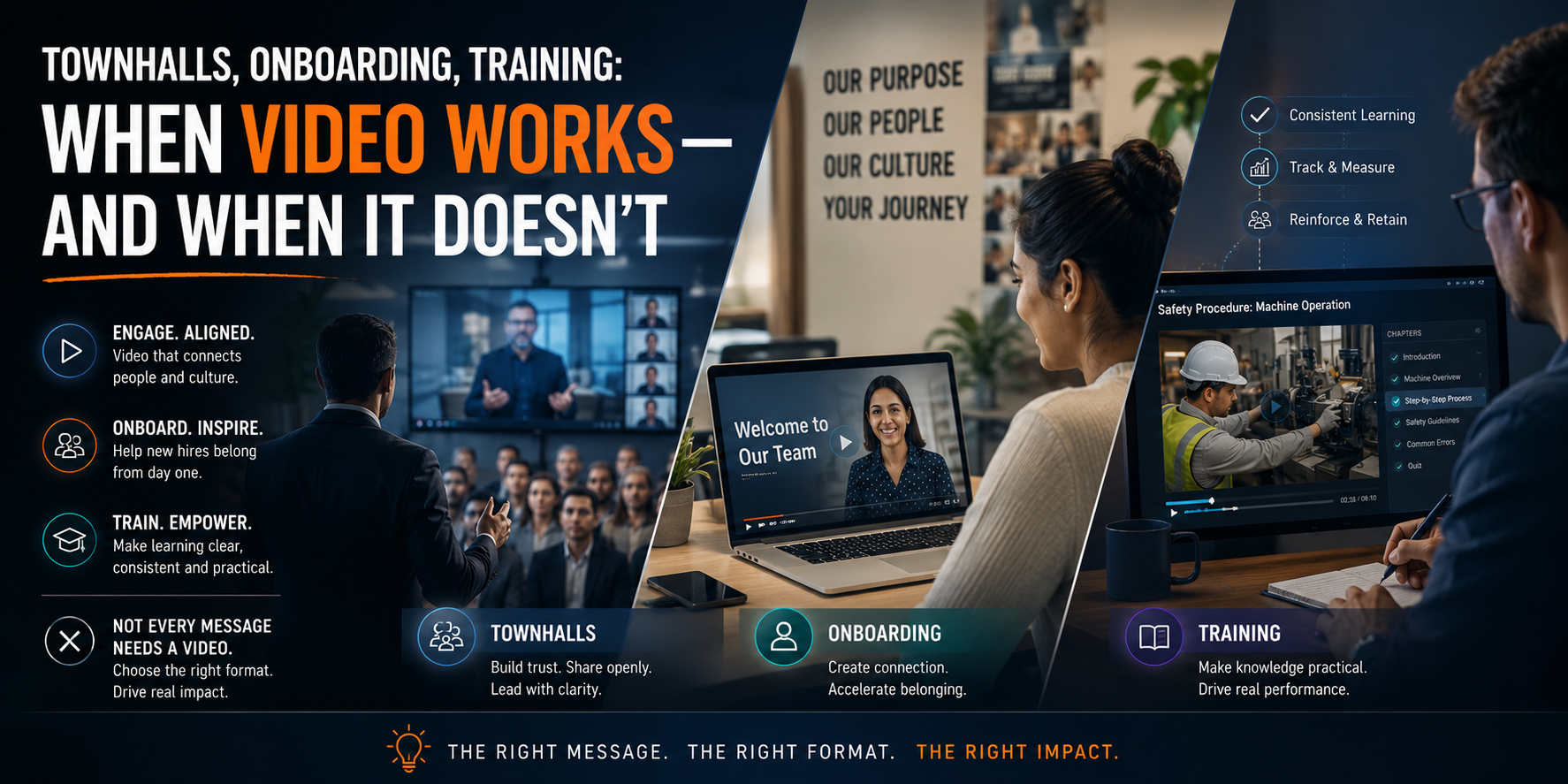
1. Leadership Town Halls
Few communication formats benefit from video more than town halls.
Employees don’t just want information—they want to see leadership.
A well-produced town hall allows employees to observe:
- Confidence
- Transparency
- Empathy
- Body language
- Tone of voice
These subtle cues build trust in ways written communication rarely can.
Even for organizations with live events, recording the session ensures remote teams receive exactly the same message.
2. Employee Onboarding
The first few weeks shape an employee’s perception of the organization.
Instead of receiving dozens of documents and presentations, new hires can experience:
- A welcome from leadership
- The company’s history and purpose
- Workplace culture
- Team introductions
- Facility tours
- Customer stories
Video transforms onboarding from an administrative process into a human experience.
More importantly, it ensures consistency regardless of who conducts the induction.
3. Process Demonstrations
Some things are simply easier to show than explain.
Whether it’s:
- Operating machinery
- Using internal software
- Following safety procedures
- Demonstrating manufacturing workflows
Video dramatically reduces ambiguity.
Employees can pause, replay, and revisit instructions whenever needed.
4. Celebrating Milestones
Organizations often underestimate the cultural value of storytelling.
Videos documenting:
- Company anniversaries
- Awards
- CSR initiatives
- Major project launches
- Employee achievements
help employees feel connected to something larger than their individual roles.
These become part of the organization’s institutional memory.
When Video Doesn’t Work
Video is powerful.
But it’s not magic.
1. Replacing Every Email
Not every announcement deserves a camera.
If employees simply need:
- a deadline
- a policy update
- a meeting reminder
a concise email is usually faster and more effective.
Turning routine updates into videos often creates unnecessary friction.
Sometimes clarity beats production value.
2. Information Overload
One common mistake is trying to fit an entire handbook into a single video.
Long presentations packed with slides, policies, and jargon rarely hold attention.
People remember stories.
They don’t remember forty consecutive PowerPoint slides narrated over stock footage.
3. Mandatory Training Without Engagement
Many compliance videos are created simply to satisfy regulatory requirements.
Employees recognise this immediately.
When training becomes a passive exercise, people often:
- play the video in the background
- skip sections
- retain very little
The issue isn’t that training videos exist.
It’s that too many focus on completion instead of comprehension.
4. Difficult Conversations
There are moments where video should never replace human interaction.
Examples include:
- performance discussions
- restructuring conversations
- conflict resolution
- personal feedback
These conversations require dialogue.
Not broadcast.
Video can support communication.
It cannot replace empathy.
The Biggest Mistake: Confusing Communication with Content
Internal videos often fail because they’re produced like marketing campaigns.
Employees don’t need to be sold to.
They need:
- clarity
- relevance
- honesty
- context
The goal isn’t entertainment.
The goal is understanding.
Quality Matters More Than Gloss
One misconception is that every internal video needs cinematic production.
It doesn’t.
Employees are remarkably forgiving of modest production quality if the communication feels authentic.
What they won’t forgive is:
- confusing messaging
- overly scripted delivery
- lack of sincerity
- unnecessary corporate jargon
Authenticity consistently outperforms perfection.
Think Like a Communicator, Not Just a Producer
Before commissioning a video, ask four simple questions:
- Does this message benefit from seeing or hearing a real person?
- Will visuals improve understanding?
- Does this require emotional context?
- Is this information likely to be revisited later?
If the answer to most of these is “yes,” video is probably the right choice.
If not, another communication format may be more effective.
Choosing the right medium is just as important as crafting the right message.
Final Thought
The most successful organizations don’t use video because it’s modern.
They use it because it’s appropriate.
Town halls, onboarding programmes, and training initiatives all benefit enormously from thoughtful video production—but only when the format serves the communication objective rather than becoming the objective itself.
At 72010 Network Pvt. Ltd., we believe every internal communication deserves the format that best serves its purpose. Sometimes that’s a professionally produced leadership film. Sometimes it’s a concise training module. And sometimes, the best communication isn’t a video at all.
If you’re rethinking how your organization communicates with its people, we’d love to help you identify where video can create the greatest impact—and where a different approach might be the smarter choice.