One of the biggest misconceptions about video production today is that AI has made everything instant.
Clients see AI-generated videos, automated editing tools, and one-click script generators and naturally ask:
“If AI can do all this, why does video production still take weeks?”
It’s a fair question.
The answer is that while AI has compressed parts of the process dramatically, the parts that determine whether a video succeeds or fails are still deeply human.
Let’s look at what a real production timeline actually looks like in 2026.
Week 1: Discovery, Strategy & Briefing
Human-Led
Before a single frame is shot, the biggest question isn’t:
“What should the video look like?”
It’s:
“What problem is this video solving?”
This stage involves:
- Stakeholder discussions
- Audience definition
- Communication objectives
- Message prioritisation
- Format selection
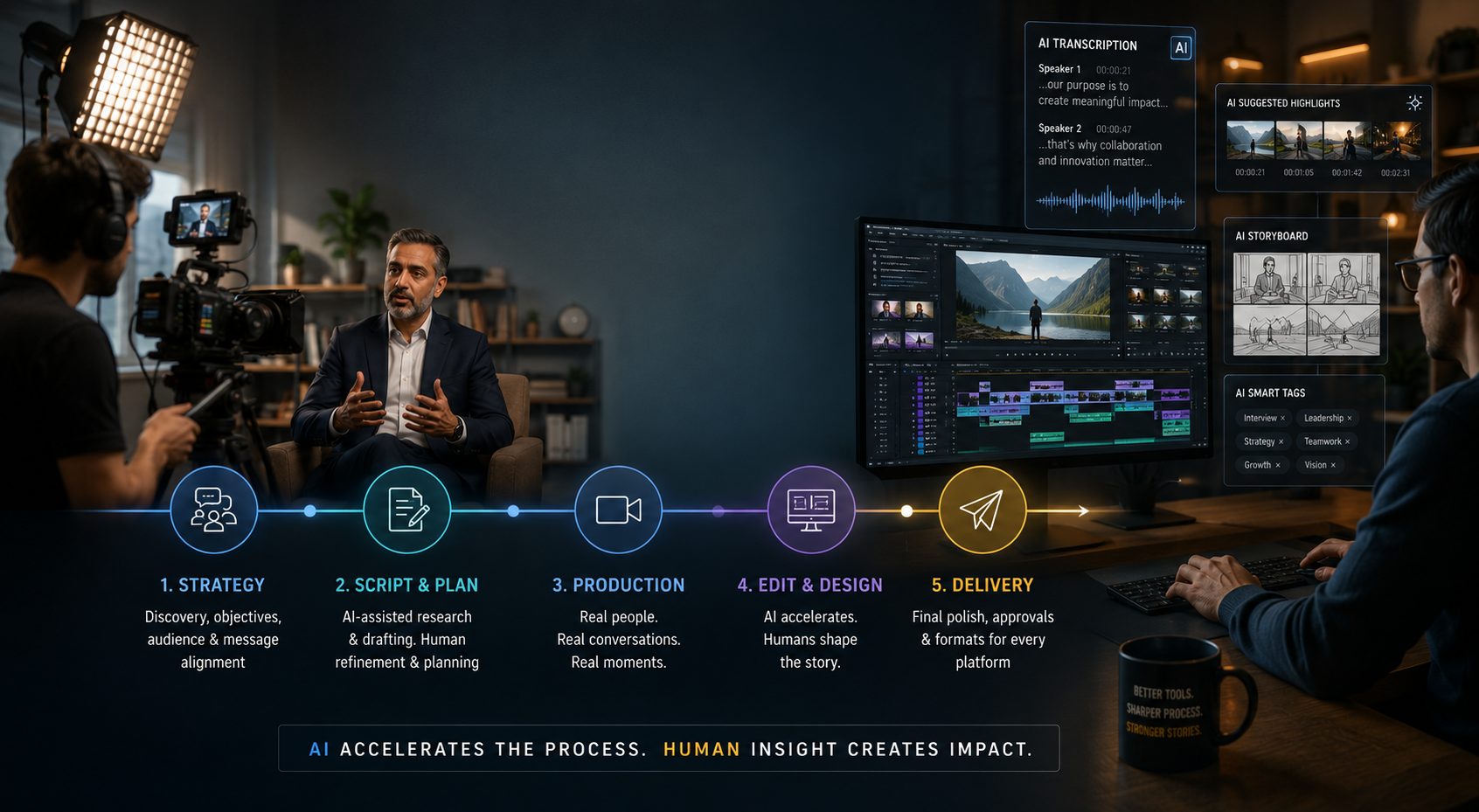
AI can help organise information.
It cannot sit in a room and navigate competing stakeholder priorities.
Week 1–2: Script Development
Human + AI
This is where AI genuinely shines.
Today’s tools can:
- Generate first drafts
- Suggest structures
- Create alternative headlines
- Summarise interview notes
Tasks that once took days may now take hours.
But here’s the catch:
AI can generate words.
It cannot determine:
- Political sensitivities
- Organisational culture
- Leadership tone
- Strategic nuance
The final script still requires human judgement.
Week 2: Pre-Production
Mostly Human
Locations.
Schedules.
Approvals.
Talent availability.
Travel logistics.
AI helps with planning and documentation.
But no AI has successfully convinced a CEO to move their calendar for a shoot.
Not yet.
Week 3: Production
Almost Entirely Human
This is where the “AI will replace filmmakers” narrative usually collides with reality.
For corporate films, documentaries, and leadership communication, production still relies heavily on:
- Interview direction
- Camera operation
- Lighting
- Sound capture
- Human interaction
Consider a documentary interview.
The most valuable moments often emerge from:
- Trust
- Curiosity
- Follow-up questions
- Reading emotion in real time
These moments cannot be prompted into existence.
They have to be earned.
Week 3–4: Editing
Human + AI
Editing has arguably seen the biggest productivity gains.
AI can now:
- Transcribe interviews
- Search footage
- Generate rough cuts
- Remove pauses
- Suggest selects
Editors can work significantly faster than they could five years ago.
But the difference between:
- a sequence that communicates information
- and a sequence that creates emotion
is still human editorial judgment.
Week 4–5: Graphics, Motion & Finishing
Human + AI
AI can generate:
- Concept visuals
- Storyboards
- Placeholder graphics
- Design inspiration
Yet clients rarely approve inspiration.
They approve finished work.
Brand compliance, visual consistency, and creative polish still require experienced designers and motion artists.
Week 5–6: Reviews, Feedback & Revisions
Entirely Human
The longest delays in most projects rarely come from technology.
They come from:
- Approvals
- Stakeholder alignment
- Additional review rounds
- Last-minute changes
No AI tool can solve organisational indecision.
And every experienced producer knows this.
The Biggest Myth: AI Makes Video Instant
AI has undoubtedly changed production.
Tasks that once consumed:
- hours
- days
- even weeks
can now happen in minutes.
But clients aren’t buying speed alone.
They’re buying:
- judgement
- clarity
- storytelling
- trust
- experience
And those remain human capabilities.
What Actually Takes Time?
The answer may surprise people.
It’s not rendering.
It’s not transcription.
It’s not formatting.
It’s deciding:
- What story should be told?
- Whose voice should lead it?
- What should be left out?
- What will make audiences care?
These questions have always been the heart of production.
And AI hasn’t changed that.
Final Thought
The future of video production isn’t human versus AI.
It’s human creativity amplified by AI efficiency.
The agencies that thrive won’t be the ones replacing people with software. They’ll be the ones using technology to eliminate busywork so they can focus more deeply on strategy, storytelling, and execution.
At 72010 Network Pvt. Ltd., we embrace AI where it genuinely adds value—but we also recognise that the most important parts of filmmaking still happen between people, not machines.
Planning a Video Project?
Whether you’re producing a leadership message, internal communications campaign, corporate documentary, or brand film, understanding the real timeline is the first step toward a successful outcome.
Talk to our team about building a production schedule that balances modern AI efficiencies with the human expertise your story deserves.