
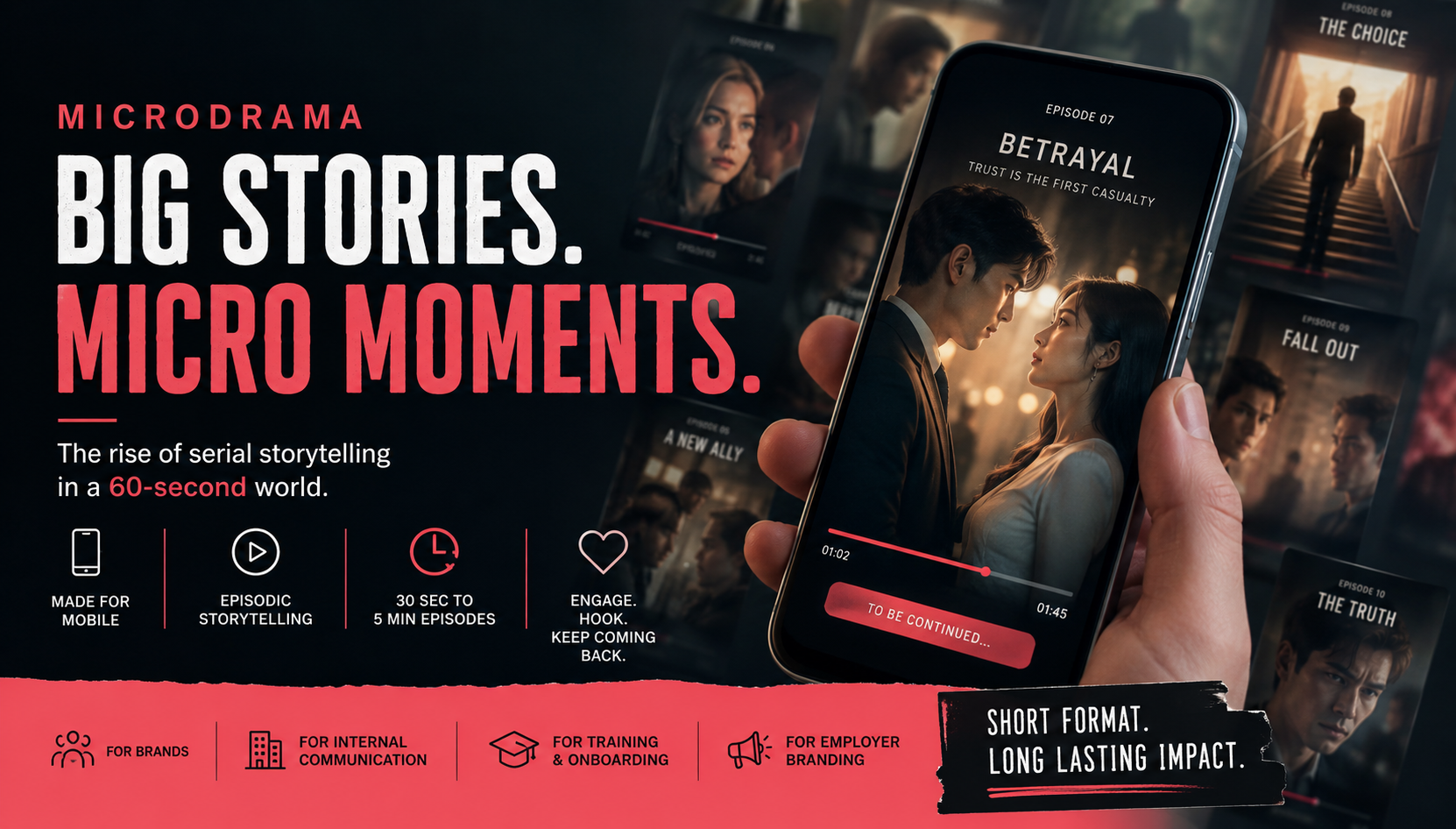
Scroll through any short-video feed today and you’ll notice something subtle but important happening. It’s no longer just random clips competing for attention. Stories are starting to continue. Characters reappear. Conflicts stretch across episodes. And suddenly, what looked like chaotic scrolling begins to resemble something older than the internet itself.
That format has a name now: microdrama.
Not quite a film. Not quite a reel. Not quite a web series either. It sits somewhere in between — and that “in-between” is exactly why it’s spreading so fast.
What Exactly Is a Microdrama?
A microdrama is a serialized story told in ultra-short episodes, usually designed for mobile-first viewing.
Typical structure:
- Episodes: 30 seconds to 3–5 minutes
- Format: Vertical video (9:16)
- Structure: Strong hook → emotional escalation → cliffhanger
- Release style: Daily or binge-dropped batches
Unlike traditional storytelling, microdrama doesn’t wait to build interest. It assumes you’re already halfway out the door.
The first three seconds are not introduction — they are survival.
Why Now? The Attention Shift Nobody Planned For
Microdrama didn’t appear randomly. It is the natural outcome of three converging shifts:
1. The collapse of patience (but not interest)
People haven’t stopped caring about stories. They’ve stopped tolerating slow entry points.
A 10-minute setup now competes with:
- infinite scroll feeds
- push notifications
- algorithmic novelty loops
So storytelling adapted by compressing the time to tension.
2. Mobile became the primary cinema
On a phone, intimacy changes everything.
A character speaking directly into a vertical frame feels closer than a carefully staged widescreen shot. Microdramas exploit this by:
- using close-ups almost exclusively
- breaking the “fourth wall” often
- designing emotional immediacy over visual grandeur
The phone isn’t just a screen anymore. It’s a proximity device.
3. Algorithms reward continuity, not closure
Short-video platforms optimize for:
- watch time
- return visits
- session depth
A cliffhanger doesn’t just end an episode — it feeds the next one. Microdrama fits this perfectly because it is structurally incomplete by design.
Completion is delayed. Curiosity is monetized.
The Unexpected Revival of Soap Opera Logic
If microdrama feels strangely familiar, that’s because it is.
It inherits the DNA of:
- television soaps
- pulp fiction serials
- radio dramas
- comic strips
But it removes the friction:
- no scheduled viewing
- no long runtime
- no commitment barrier
What remains is pure narrative tension:
“What happens next?”
This is storytelling stripped down to its most addictive mechanism.
Why China Became the Early Epicenter
The format scaled rapidly in China due to a combination of:
- mature short-video ecosystems
- highly optimized recommendation engines
- strong mobile payment integration for premium episodes
- massive creator supply chains
Entire studios now produce microdramas like assembly lines:
- script factories
- fast shoots
- template editing
- algorithm testing loops
It is industrialized storytelling — not artisanal filmmaking.
The Three Ingredients That Make Microdramas Work
1. Instant conflict
There is no warm-up phase.
A microdrama often begins with:
- betrayal already happening
- a secret already exposed
- a relationship already collapsing
The story doesn’t start at “once upon a time.”
It starts at “you won’t believe what just happened.”
2. Emotional exaggeration
Subtlety struggles here. Microdramas thrive on:
- heightened emotion
- clear moral polarity
- sharp reversals
Not because audiences are simplistic, but because the format rewards fast readability.
3. Structural addiction loops
Each episode is engineered like a behavioral trigger:
- unresolved tension
- partial revelation
- immediate cliffhanger
It’s less “story arc” and more “story spiral.”
The Agency Opportunity Nobody Can Ignore
For communications agencies, microdrama is quietly becoming interesting for a reason most people miss:
It is not just entertainment — it is a format for structured attention design.
That means it can be applied to:
- onboarding journeys
- training narratives
- employer branding
- product education
- internal communication storytelling
Imagine instead of a corporate explainer video:
a 12-episode workplace story showing real dilemmas, decisions, and consequences
Suddenly, compliance training doesn’t feel like reading. It feels like following a narrative.
Microdrama in Corporate Communication: The Early Signals
We are already seeing early experiments:
- “a day in the life” serialized into episodes
- fictionalized office scenarios for HR training
- founder story arcs split into short chapters
- product journeys told as narrative conflicts
It reframes communication from:
“Here is information”
to:
“Here is a story you inhabit”
The Risk: When Everything Becomes Too Engineered
Like all formats optimized for attention, microdrama carries a tension.
The risk is:
- formula fatigue
- emotional manipulation
- repetitive tropes
- shallow storytelling disguised as intensity
When every story is engineered for retention, authenticity becomes the differentiator again.
The strongest creators will not be the ones who understand algorithms best — but those who can still surprise human expectation inside algorithmic constraints.
Where This Is Going Next
Microdrama is likely not a trend. It is a transitional format.
We are moving toward:
- episodic vertical storytelling as default
- AI-assisted script generation pipelines
- hyper-localized micro series
- brand-funded narrative universes
And increasingly:
- stories designed not for completion, but for continuation
Final Thought
Microdrama is not really about short videos.
It is about what happens when storytelling adapts fully to the attention economy — and discovers that the best way to hold attention is not to demand it, but to earn it every 60 seconds again.
In that sense, it is not new at all.
It is simply ancient storytelling wearing a very modern interface.
Want to use this for your brand or communication work?
For communications teams and agencies, microdrama isn’t just a trend to observe — it’s a format worth experimenting with. The real opportunity is not in copying entertainment tropes, but in translating structured storytelling into onboarding journeys, employer branding, training modules, and leadership communication.
As a communications agency, we can help you:
- convert complex corporate messages into microdrama-style episodic narratives
- design 10–20 episode internal communication or training story systems
- build repeatable storytelling frameworks that scale across formats (video, LinkedIn, internal platforms)
- reimagine employer branding as serialized, human-first storytelling instead of static content
If you’re exploring how to make your communication more engaging, memorable, and mobile-native, this is a format worth testing before it becomes mainstream.