Growth changes organizations.
So do mergers.
So does restructuring.
New leadership enters. Teams expand. Processes evolve. Reporting structures shift. What once felt familiar can suddenly begin to feel fragmented.
And in these moments, the biggest challenge is rarely operational.
It’s cultural.
Because when organizations change rapidly, communication gaps widen. Assumptions multiply. Employees begin filling uncertainty with speculation.
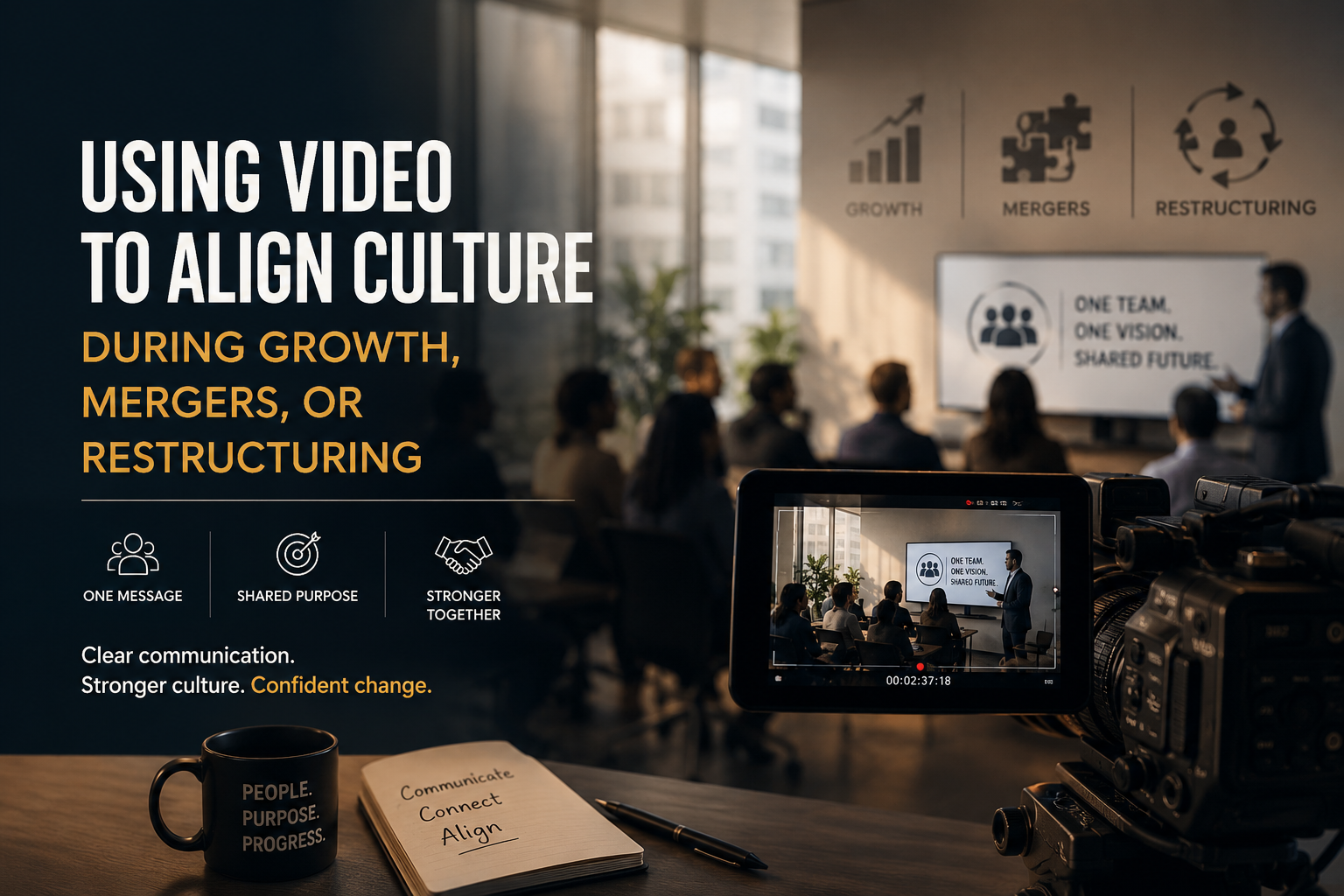
This is where video becomes more than a communication format.
It becomes a cultural alignment tool.
The Hidden Risk During Organisational Change
Most companies focus heavily on the structural side of change:
- Systems
- Processes
- Reporting hierarchies
- Financial integration
But culture doesn’t integrate automatically.
Employees start asking questions internally—even if they never say them out loud:
- “What does this mean for us?”
- “Is leadership aligned?”
- “What changes now?”
- “Do the company values still hold?”
If these questions remain unanswered, uncertainty grows into organisational noise.
And culture slowly begins to drift.
Why Traditional Communication Often Fails During Transition
In periods of change, organizations tend to increase communication volume:
- More emails
- More meetings
- More documents
- More presentations
But more communication does not automatically create clarity.
In fact, during restructuring or mergers, text-based communication often:
- Feels impersonal
- Gets interpreted differently across teams
- Lacks emotional reassurance
- Creates inconsistent understanding
Employees don’t just need information during change.
They need context, tone, and trust.
Why Video Works Differently
Video carries something other communication formats struggle to preserve:
👉 Human presence.
People can:
- See leadership
- Hear tone and intent
- Observe confidence, empathy, and clarity
This matters enormously during periods of uncertainty.
A well-crafted video can:
- Reduce speculation
- Reinforce shared values
- Align teams around a common direction
- Humanise organizational decisions
Instead of fragmented interpretations, employees experience the same message, delivered with the same intent.
Alignment Is Emotional Before It’s Operational
One of the biggest misconceptions about organizational change is that alignment is purely strategic.
It’s not.
Before employees align with:
- New structures
- New goals
- New processes
…they need to emotionally understand:
- Why change is happening
- What leadership believes in
- Whether they still belong in the future being described
This is where video becomes uniquely effective.
Because culture is not built through bullet points.
It is built through shared understanding and emotional consistency.
Where Video Has the Greatest Impact During Change
Leadership Communication
Employees want to hear directly from leadership—not filtered through layers of interpretation.
A strong leadership video:
- Reduces distance
- Builds trust
- Creates clarity around direction and intent
Merger Integration
When two organizations come together, culture can become fragmented quickly.
Video helps:
- Introduce leadership teams
- Explain shared vision
- Reinforce common values
- Create familiarity between teams
Without this, “us vs them” dynamics can emerge silently.
Restructuring & Change Management
Periods of restructuring create uncertainty even among high-performing teams.
Video allows organizations to:
- Communicate difficult decisions with empathy
- Maintain transparency
- Preserve morale during transition
The tone of communication matters as much as the message itself.
Reinforcing Culture at Scale
As organizations grow, culture becomes harder to preserve consistently.
Video helps maintain:
- Leadership visibility
- Shared messaging
- Organizational identity across locations and departments
Especially in distributed or hybrid teams, this becomes critical.
The Mistake Companies Make
Many organizations treat change communication videos like announcements:
“Here’s what’s changing.”
But employees are actually listening for:
“Do leadership understand what this change feels like?”
That distinction changes everything:
- Script
- tone
- pacing
- delivery
The most effective internal videos are not just informative.
They are reassuring, intentional, and human.
What Effective Culture-Alignment Videos Share
The strongest videos during organizational change tend to have a few things in common:
Clarity
No jargon. No corporate abstraction.
Honesty
Employees can detect over-polished messaging instantly.
Narrative Structure
People need to understand:
- Where the organization was
- Why change is happening
- Where it’s going next
Visible Leadership Alignment
Mixed messaging destroys trust quickly.
Emotional Intelligence
Acknowledging uncertainty often builds more confidence than pretending it doesn’t exist.
Final Thought
During periods of growth or transition, culture becomes fragile.
And fragile cultures are rarely repaired through documents alone.
Video, when approached thoughtfully, helps organizations create:
- Shared understanding
- Consistent messaging
- Emotional alignment
- Trust during uncertainty
Because in moments of change, employees are not just listening to what leadership says.
They are watching how it is being said.
Let’s Help Your Organisation Communicate Change Clearly
Whether your organization is scaling rapidly, navigating restructuring, or integrating teams after a merger, communication cannot be left to chance.
Connect with 72010 Network Pvt. Ltd. to create internal video communication that aligns culture, builds trust, and helps teams move forward together.